


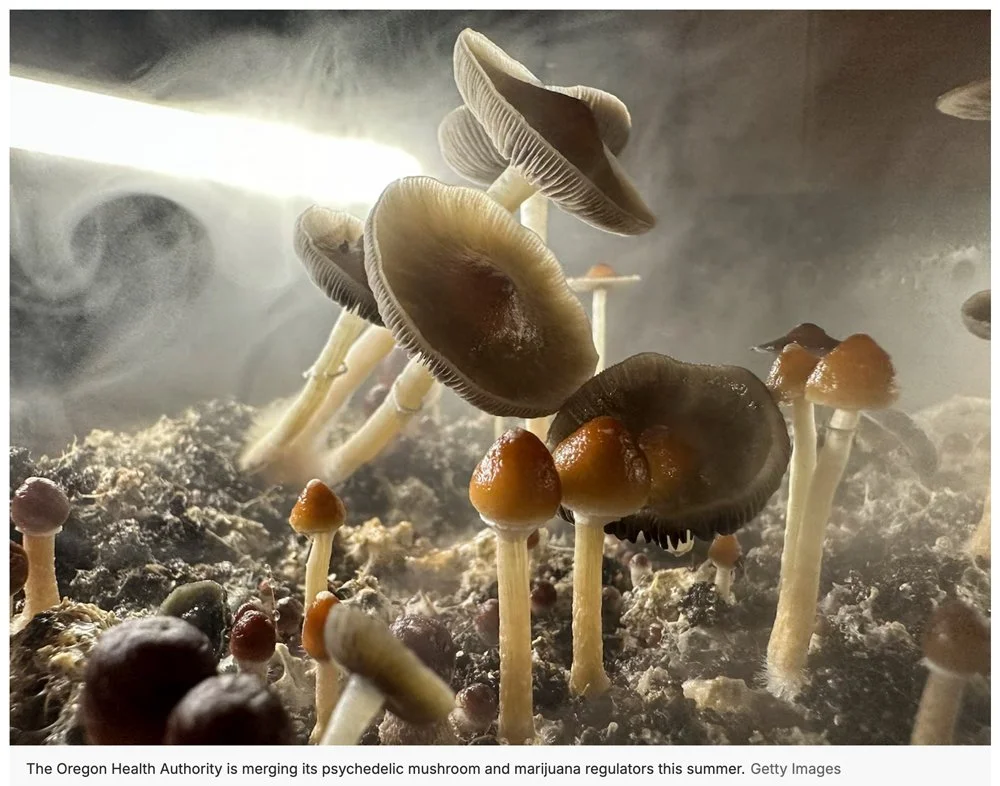

The Oregon Health Authority is making administrative changes to its psychedelic mushroom and marijuana regulators this summer, some of which are stirring industry concern.
Oregon Psilocybin Services and the Oregon Medical Marijuana Program, both “experiencing budget shortfalls,” will be merged by Sept. 1, the Oregon Health Authority confirmed Wednesday. Despite cutting costs and leaving open positions empty, agency officials deemed a merger to be the most cost-effective solution.
Angela Allbee, Oregon Psilocybin Services section manager, will lead the newly merged Oregon Psilocybin and Medical Cannabis Section. The medical marijuana section manager, Megan Lockwood, is moving to the Health Licensing Office as interim director after current director Bob Bothwell retires.
In 2020, Oregon voters approved the Oregon Psilocybin Services Act to allow supervised use of psychedelic mushrooms. Measure 109, which passed with roughly 56% of the vote, made Oregon the first state in the country to establish a licensing framework. Advocates heralded the psychedelics, then and still designated federally as a Schedule 1 drug, as a treatment for depression, anxiety and addiction. They pointed to years of studies and argued the drugs should be accessible to the public under the purview of the Oregon Health Authority. Voters agreed, and the state built out an administrative structure.
But in 2026, industry leaders are worried about the impact of new licensing fees proposed by the Oregon Health Authority, particularly as it coincides with a decline in business.
“They’ll have public listening sessions, everyone will tell them, ‘Don’t do this,’” said Andreas Met, founder of Satya Therapeutics in Medford, one of the first licensed manufacturers in the state. “It will kill the industry.” Next week, an Oregon Psilocybin Services rules advisory committee will discuss next year’s proposed rules, including the fee changes. Measure 109 required the service to fund itself with fees rather than using tax dollars.
“Due to rising costs that are outside of OPS’ control, increasing fees is the only option to support budget and program sustainability,” the division’s website states. The process will open for public comment on Sept. 1.
“A fee-based structure with rising costs is always going to be a formula for having to do some problem-solving,” Allbee told Lucid News, a psychedelics-focused publication, in February.
The marijuana service will also convene a rules advisory committee to assess changes to cannabis testing regulations, though not until later this summer. Like psilocybin therapy, medical marijuana was approved by voters in 1998, followed by recreational marijuana in 2014.
Under new proposals, licensing fees for psilocybin manufacturers and service centers would double from $10,000 to $20,000; the fee for facilitators would jump from $2,000 to $4,000. The price for laboratory licenses and renewals would remain at $10,000 until 2029, then double to $20,000.
“Once they increase the fees, companies will definitely go out of business,” said Rose City Laboratories CEO Dan Huson. “People are struggling already.”
Huson said Oregon’s psilocybin industry has been struggling in recent years, with customers finding cheaper treatments in Colorado or New Mexico and because of the availability of unregulated psychedelics, products designed to differ from banned drugs and sold in a legal gray area, at vape shops and corner stores.
One of Portland’s earliest and most ambitious facilities for legal psychedelic mushrooms, InnerTrek Center for Psilocybin Services, closed last month. Tom Eckert, a chief architect of the ballot initiative, was involved in founding the center. The New York Times reported in January that one-third of Oregon’s 36 licensed service centers had closed, which it attributed to high regulatory costs. Met said they number in the low 20s today. In addition to financial struggles, Johns Hopkins University researchers found Oregon’s program “has expanded supervised psilocybin use beyond strictly medical uses,” potentially raising safety concerns. The Oregon Health Authority is experiencing funding challenges from both federal grant cuts and policy changes. On Thursday, the health authority’s director, Dr. Sejal Hathi, resigned after a turbulent tenure marred by patient safety and workplace culture concerns at the Oregon State Hospital, a psychiatric facility operated by the agency.
President Donald Trump has shifted the federal government’s stances on both medical marijuana and psychedelics. This year, he has signed an executive order reclassifying state-licensed medical marijuana as a less-dangerous drug and another directing the Food and Drug Administration to speed up psychedelics research.